
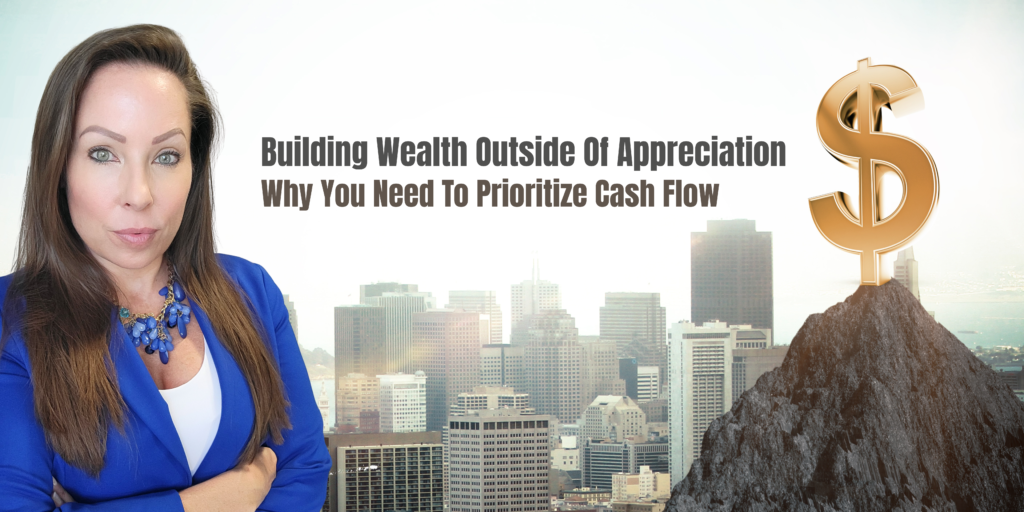
The Wise Way To Build Wealth
For decades, many real estate investors have relied on one thing to build wealth: appreciation.
Buy a property. Wait. Watch it increase in value. Refinance. Repeat.
For years, especially during periods of historically low interest rates, that strategy worked remarkably well. Investors could purchase almost any property, collect modest rent, and let rising prices do most of the heavy lifting.
But today’s market tells a very different story.
Higher interest rates, tighter lending standards, rising operating costs, increasing insurance premiums, property tax hikes, and slower price growth have exposed a harsh reality:
Appreciation isn’t a business model. It’s a bonus.
The investors who continue to thrive aren’t simply waiting for prices to rise. They’re intentionally creating wealth through multiple avenues that have very little to do with market speculation.
If your investment strategy depends entirely on appreciation or monthly cash flow, you may be leaving enormous amounts of wealth on the table.
Appreciation Is Something You Hope For. Wealth Is Something You Build.
Nobody can accurately predict where real estate prices will be five or ten years from now.
Markets fluctuate.
Governments change policies.
Interest rates rise and fall.
Economic conditions evolve.
Yet many investors continue making purchase decisions based almost entirely on what they think a property might be worth someday.
That’s speculation.
Successful investors ask a different question:
“How can I create value regardless of what the market does?”
That shift in thinking changes everything.
Instead of becoming dependent on market appreciation, they focus on increasing income, reducing expenses, improving operations, creating equity, optimizing taxes, and using capital more efficiently.
Those are factors they can actually control.
Cash Flow Is Great…But It Isn’t the Whole Picture
Cash flow is often considered the holy grail of investing.
Positive monthly income provides stability, helps weather economic downturns, and allows investors to continue acquiring additional assets.
But cash flow alone rarely creates extraordinary wealth.
A property producing $300 per month is certainly better than losing money, but at that pace it can take decades to create meaningful financial freedom.
Sophisticated investors understand that real estate produces wealth in multiple ways simultaneously.
The most successful deals often combine several wealth-building strategies into one investment.
Forced Appreciation Creates Wealth You Control
One of the most powerful forms of appreciation isn’t natural appreciation at all.
It’s forced appreciation.
Rather than waiting for market values to increase, investors intentionally increase a property’s value by improving its performance.
This might include:
- Renovating units
- Modernizing common areas
- Increasing rental income
- Reducing vacancy
- Improving tenant retention
- Lowering operating expenses
- Adding amenities
- Implementing better property management
Commercial real estate illustrates this perfectly.
Unlike residential housing, commercial property values are largely determined by the income the property generates.
Increase the property’s Net Operating Income (NOI), and its value often increases dramatically.
Sometimes relatively small operational improvements can create hundreds of thousands—or even millions—of dollars in additional equity.
That’s wealth creation.
Not speculation.
Equity Can Be Manufactured
Many people think equity only comes from appreciation.
That’s simply not true.
Investors create equity every day by purchasing below market value.
This can happen through:
- Off-market opportunities
- Distressed sellers
- Estate sales
- Underperforming properties
- Value-add acquisitions
- Vendor take-back financing
- Creative negotiations
Buying well immediately creates wealth before any renovations even begin.
Great investors often say:
“You make your money when you buy.”
Selling simply realizes the value that was created at acquisition.
Tax Efficiency Is an Often Overlooked Wealth Builder
One of real estate’s greatest advantages isn’t the rental income.
It’s the tax benefits.
Successful investors spend just as much time thinking about after-tax returns as they do gross returns.
Strategies may include:
- Capital cost allowance (CCA)
- Depreciation
- Mortgage interest deductions
- Expense write-offs
- Cost segregation studies
- Capital gains planning
- Holding companies
- Trust structures
- Tax-efficient refinancing
Keeping more of what you earn often has a larger impact on long-term wealth than increasing your annual return by another percentage point.
This is one reason experienced investors work closely with accountants who specialize in real estate rather than relying solely on general tax preparation.
Leverage Multiplies Wealth
Real estate remains one of the few asset classes where investors can control large assets using relatively small amounts of their own capital.
When used responsibly, leverage becomes an extraordinary wealth-building tool.
Imagine purchasing a $1 million property with a 25% down payment.
You’re controlling a million-dollar asset while investing only $250,000.
If that property increases in value through operational improvements—not speculation—the return on your invested capital can be substantial.
Of course, leverage also magnifies risk.
The goal isn’t to maximize debt.
It’s to use financing strategically while maintaining healthy cash reserves and conservative underwriting.
Recycling Capital Accelerates Growth
Many experienced investors don’t leave equity trapped inside properties indefinitely.
Instead, they recycle it.
This may involve:
- Refinancing after increasing value
- Completing a value-add project
- Selling stabilized assets
- Completing tax-efficient exchanges where available
- Reinvesting into larger opportunities
Instead of saving for years to purchase another property, they allow existing investments to fund future acquisitions.
Their money keeps working instead of sitting idle.
This creates exponential rather than linear portfolio growth.
Business Systems Often Produce More Wealth Than Properties
One surprising lesson many commercial investors discover is that their real estate business eventually becomes more valuable than the real estate itself.
Think about it.
A well-run investment company develops:
- Deal sourcing systems
- Investor relationships
- Operating procedures
- Brand recognition
- Property management expertise
- Acquisition teams
- Financing relationships
- Asset management capabilities
These systems create repeatable results.
Rather than depending on one successful investment, they create a business capable of producing successful investments consistently.
That’s scalable wealth.
Relationships Produce Returns No Spreadsheet Can Measure
Real estate remains a relationship business.
The right introductions often lead to:
- Off-market deals
- Preferred financing
- Joint ventures
- Private lending
- Equity partners
- Strategic mentors
- Better contractors
- Experienced operators
Many investors focus exclusively on analyzing properties while neglecting to build relationships.
Ironically, many of the best opportunities never appear publicly.
They circulate through trusted networks long before reaching the market.
Your network often determines the quality of opportunities you’ll see.
Knowledge Compounds Like Capital
The first investment teaches you lessons.
The tenth investment teaches you judgment.
The hundredth investment teaches you pattern recognition.
Every negotiation, renovation, financing challenge, tenant issue, and market cycle builds experience that cannot be purchased.
Knowledge compounds just like money.
The investors who continually educate themselves—through books, coaching, conferences, masterminds, podcasts, and mentorship—often outperform those relying solely on experience.
Markets evolve.
Successful investors evolve with them.
Diversification Creates Resilience
Many investors focus entirely on one strategy.
Perhaps it’s BRRRRs.
Or flips.
Or multifamily.
Or short-term rentals.
The strongest portfolios often generate wealth from several complementary sources:
- Residential rentals
- Multifamily
- Industrial properties
- Self-storage
- Private lending
- Real estate funds
- Development projects
- Passive syndications
Different asset classes perform differently across economic cycles.
Diversification reduces reliance on any single market trend.
Wealth Is Built Through Intentional Decisions
It’s tempting to believe successful investors simply got lucky buying during the right market cycle.
While timing certainly helps, long-term wealth usually comes from disciplined execution.
The investors who continue growing regardless of market conditions focus on controllable variables:
- Buying quality assets
- Improving operations
- Increasing income
- Managing expenses
- Protecting downside risk
- Building relationships
- Using leverage responsibly
- Optimizing taxes
- Reinvesting capital
- Continuing their education
Those principles work during booming markets.
They also work during challenging ones.
What Goes Up Doesn’t Always Stay Up
Real estate has created more millionaires than perhaps any other investment class—but not because appreciation always goes up.
The most successful investors understand that appreciation is only one piece of a much larger wealth-building puzzle.
When you stop relying on speculation and start intentionally creating value, your entire approach to investing changes.
Instead of hoping the market makes you wealthy, you build systems that generate wealth regardless of what tomorrow’s headlines say.
That’s the difference between gambling on real estate and building a real estate business.
Because in the end, the greatest investors don’t simply own properties.
They own systems, relationships, knowledge, and businesses that continue creating wealth long after a single property’s value has changed.
Let’s build wealth the smart way, together!
And, if you’re thinking about buying, selling or investing in Durham Region or Toronto, let’s chat! I can be reached at 647-896.6584, by email at info@serenaholmesrealtor.com or by filling out this simple contact form.
In addition, make sure we’re connected on social and you’ve subscribed to my YouTube Channel. And, for other articles specific to real estate investing, click here.