

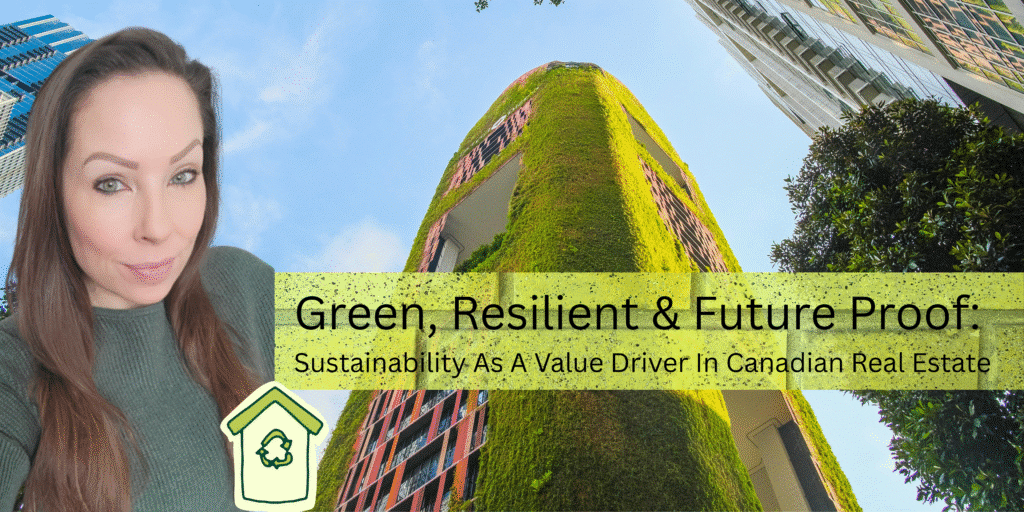
Green, Resilient & Future-Proof: Sustainability as a Value Driver in Canadian Real Estate
Investing in real estate isn’t just about location, square footage, and cash flow anymore.
If you’re anything like me, you’re waking up to the fact that sustainability is no longer a nice-to-have buzzword. It’s a value driver.
1. Why sustainability matters in property value
Canada’s building sector is responsible for roughly 18 % of our GHG emissions — direct heating plus electricity. When you include embodied carbon (materials, construction processes), that rises to near 28 %.
Put another way: the buildings we own, sell, invest in, will have to deal with a changing climate, evolving codes, tenant/occupant expectations — and that impacts risk and reward. Some examples that stick with me:
- A recent survey showed 39 % of Canadians say climate-related factors (flood, wildfire, extreme weather) will impact where they buy a home in the next five years.
- In Ontario & Quebec alone, wind-storm losses from 2008–21 topped CA$5.2 B; climate risk is already having a measurable effect on property and insurance.
If I’m listing a house, and a buyer knows the home has been retrofitted for energy efficiency, has a resilient envelope, or has flood risk mitigated, THAT is a story I want to tell.
Because sustainability translates into tangible benefits: lower operating costs, less downtime from weather events, more attractive to forward-thinking buyers/tenants, possibly even premium pricing.
2. How this plays out in Canada’s real-estate market
Let’s break the mechanics down.
a) Cost savings & margins — Green upgrades such as better insulation, high-efficiency heating/cooling, smart controls, even on-site renewables reduce operating costs. For commercial assets this means better NOI, for residential it means owner/tenant savings. The economics aren’t always straightforward (some deep retrofits have long paybacks) but the savings add up.
b) Risk mitigation & resilience — Properties that are vulnerable to extreme weather, or which have high carbon-intensive systems, face higher risks: insurance cost hikes, regulation changes (e.g., carbon pricing), tenant/occupant push-back, and obsolescence. Investing in resilience now helps lock in value.
c) Evolving codes & expectation gap — Canada ranks third globally for LEED-certified buildings, which signals strong uptake of green-certified construction. But the gap is with existing building stock. Much of what stands will still be standing in 2050 — so retrofit and upgrade take on major significance.
d) Demand premium & marketing advantage — Being able to say “this building is energy-efficient, low-carbon, future-proof” resonates with certain buyer segments. That’s especially true in markets like the GTA where buyers have choice and are increasingly climate-informed.
3. What “future-proofing” looks like for you in the GTA/Durham region
Since you’re deeply familiar with the local market (and listing in that space), here are some actionable ideas you can weave into your value proposition:
- Highlight envelope upgrades: In older homes, things like upgraded insulation, air-sealing, high-efficiency windows will stand out. Even if the cost is front-end, the story of lower heating bills and comfort resonates.
- Point out climate resilience features: For instance, flood-proofing in low-lying areas, storm-hardening, smart drainage, backup power/EV-charging readiness. These features are intangible differentiators but increasingly tangible to buyers.
- Leverage certification or audit reports: If a building is LEED, Energy Star, or has a third-party energy audit showing improved performance — that becomes a marketing asset.
- Tell the stories: Use your listing copy and your client-education tools to tell the “green story” — how this asset is positioned for the future, what it will cost to maintain, how it aligns with policy/regulation shifts. You’re already educating clients; this is just another layer.
- Think ahead to regulation: Ontario and other provinces will continue tightening code and emissions targets. Properties that anticipate and adapt will fare better. It’s not just “nice to have” but “must have” if you don’t want to be left with an onerous upgrade later.
4. Investment-mindset: Why this matters for investors
Given your real-estate investor perspective, this theme is crucial. Here’s how I see it:
- Cash-flow enhancement: Lower utility/maintenance costs improve returns. In multi-unit or rental properties in Durham Region, that can be the difference in yield margins.
- Value appreciation: As demand shifts, properties that are green or resilient are likely to command better resale or tenant value.
- Access to capital & financing: More lenders and investors are factoring ESG (environmental, social, governance) or sustainability metrics into their underwriting. A building with strong sustainability credentials may access more favourable terms.
- Obsolescence risk reduction: The flip-side of value creation is risk of value erosion. Neglecting the sustainability/resilience piece may leave you exposed to heavy retrofits or regulatory costs down the line.
5. A word of caution and speculation
While I firmly believe sustainability is a value driver, there are a few caveats worth flagging (and this is my speculation):
- Up-front cost caveat: Some green upgrades still have considerable upfront cost, and the pay-back period may be longer than some investors are comfortable with.
- Green-washing risk: As the REIC article notes, without consistent third-party verification or enforcement there’s a risk of inflated claims around “green” or “sustainable” features.
- Market segmentation: Not all buyers will pay a premium (yet), especially in price-sensitive segments. The value of sustainability may differ between premium condos in Toronto vs. more mid-market homes in Durham.
- Speculative regulatory shifts: I speculate that Ontario (and other provinces) will accelerate mandates around building performance, but timing and cost are uncertain. Investors and agents who anticipate this will have a head-start; those who don’t may be caught off-guard.
6. For you, as a REALTOR® and investor in Durham/GTA
Given your profile (agent + investor + educator), here’s how to integrate this into your brand and client experience:
- In listing presentations: include a “sustainability & resilience” slide — summarise what the property offers, what upgrade potential exists, what the long-term cost and market benefits are.
- In your investor-education work: highlight this trend in your blogs/webinar series — “Why sustainable homes in Durham Region are better positioned for 2030-2050”.
- For clients: Ask questions like “How important is long-term energy cost control or climate resilience to you?” That kind of conversation positions you as leading and value-driven.
- For acquisition/investment properties: Evaluate the retrofit potential, resilience risk (flood, storm, etc.), and how sustainability features can differentiate the asset.
From A Canadian Point Of View
In the Canadian context, especially Ontario’s dynamic market, sustainability is not just a regulatory box to tick. It’s a value lever.
The stories we tell, the features we highlight, the future-proofing we incorporate — all of these elevate the property beyond the physical structure.
They speak to smart investing, to being aligned with where demand is heading, and to building trust with clients who are increasingly thinking long-term.
If you lean into this narrative, telling it with authenticity, connecting it to real estate fundamentals (cost, risk, demand, financing), you’ll be helping clients not only buy or sell a home, but invest in future-proof value.
Let’s build wealth the smart way – together!
And, if you’re thinking about buying, selling or investing in Durham Region or Toronto, let’s chat! I can be reached at 647-896.6584, by email at info@serenaholmesrealtor.com or by filling out this simple contact form. You can also kick off your search for Durham Region homes for sale by clicking here.
In addition, make sure we’re connected on social and you’ve subscribed to my YouTube Channel. And, for other articles specific to real estate investing, click here.