

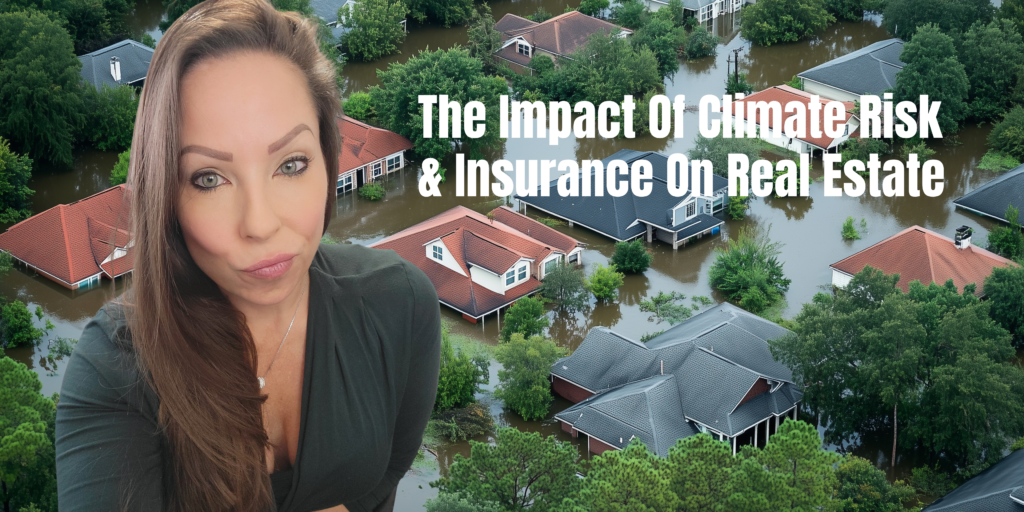
The Hidden Shift In Real Estate & Why Climate Risk + Insurance Are Becoming Major Market Factors
For decades, most real estate conversations focused on the same core drivers:
- location
- interest rates
- inventory
- school districts
- appreciation potential
- development growth
But there’s another factor quietly becoming more important in real estate markets around the world — and many buyers and investors still aren’t paying enough attention to it.
Climate risk.
More specifically, how climate-related events are beginning to impact:
- insurance costs
- property values
- lending decisions
- investor demand
- long-term desirability
This isn’t just a conversation happening in wildfire-prone parts of California or hurricane zones in Florida anymore.
Canada is increasingly feeling these pressures too.
Flooding events, severe storms, extreme heat, rising insurance claims, and infrastructure strain are forcing both homeowners and the insurance industry to reassess risk in ways that could significantly influence real estate over the next decade.
And honestly, this may become one of the most underappreciated trends shaping future property values.
Climate Risk Is No Longer Theoretical
For a long time, climate discussions felt distant for many Canadians.
But today, severe weather events are becoming more frequent and more expensive.
Across Canada, we’ve seen increasing concerns around:
- flooding
- ice storms
- severe rainfall
- wildfire smoke
- extreme heat
- wind damage
- infrastructure overload
Urban flooding in particular has become a growing issue in major markets including the GTA.
Many older neighbourhoods were never designed to handle the volume of rainfall events we’re now experiencing. Aging stormwater systems are being pushed beyond capacity, leading to basement flooding, sewer backups, and costly property damage.
For homeowners, these aren’t abstract environmental conversations anymore.
They’re financial ones.
Insurance Costs Are Rising — And Fast
One of the clearest signs of this shift is what’s happening with insurance.
Home insurance premiums have been rising steadily across many parts of Canada, and climate-related claims are a major reason why.
Insurance companies operate entirely around risk assessment.
When severe weather claims increase, insurers respond by:
- raising premiums
- tightening coverage
- increasing deductibles
- limiting policies in high-risk areas
- requiring additional mitigation measures
And this creates a ripple effect across real estate.
Historically, buyers rarely considered insurance costs as a major factor when evaluating properties.
Today, that may start changing.
Because even if a buyer technically qualifies for a mortgage, dramatically higher insurance costs can still impact affordability significantly over time.
This becomes especially important for investors evaluating long-term cash flow.
A property with rising insurance expenses may slowly erode profitability even if rental income remains stable.
Flood Risk Is Becoming A Bigger Concern
In Canada, flooding is increasingly viewed as one of the largest climate-related risks facing homeowners.
And unlike some risks that feel geographically isolated, flooding can impact both urban and suburban communities.
Many homeowners don’t fully understand:
- floodplain exposure
- overland flood risk
- sewer backup vulnerability
- drainage infrastructure limitations
until a major event occurs.
The challenge is that climate patterns appear to be increasing the frequency and severity of heavy rainfall events.
That puts additional pressure on municipalities, infrastructure systems, insurers, and homeowners simultaneously.
Over time, areas with repeated flooding issues may begin experiencing:
- higher insurance premiums
- reduced buyer demand
- lower resale desirability
- stricter lending scrutiny
This doesn’t mean entire neighbourhoods suddenly collapse in value.
But it does mean climate resilience could increasingly influence buyer psychology.
Investors Are Starting To Pay Attention
Sophisticated investors are already analyzing climate risk more seriously than many individual homeowners.
Institutional investors increasingly evaluate:
- flood maps
- infrastructure resilience
- wildfire exposure
- insurance trends
- long-term environmental vulnerabilities
- municipal adaptation plans
before deploying capital.
Why?
Because large investors think in decades.
They’re not simply evaluating what a property is worth today. They’re trying to assess what markets may look like 10, 20, or 30 years from now.
And properties exposed to increasing environmental risks may face growing financial pressure over time.
This is particularly relevant in sectors like:
- multifamily housing
- commercial real estate
- industrial assets
- hospitality
- waterfront developments
where operational disruptions and insurance costs can materially affect returns.
Insurance Availability Could Become A Major Issue
One of the most interesting long-term questions is whether some markets could eventually face reduced insurance availability altogether.
We’re already seeing examples globally where insurers have pulled back from particularly high-risk regions because claims became too unpredictable or unprofitable.
Canada is not at that stage broadly.
But the direction of the trend matters.
If insurers begin selectively limiting coverage in certain areas or dramatically increasing premiums, it could affect:
- financing approvals
- resale demand
- investor appetite
- property liquidity
Because ultimately, real estate markets depend heavily on confidence.
And confidence weakens when risk becomes harder to price.
Climate Resilience May Become A Selling Feature
What’s fascinating is that climate risk may also create opportunity.
As awareness grows, buyers may increasingly value properties and communities that demonstrate resilience.
Features that once felt secondary may become major advantages:
- upgraded drainage systems
- sump pumps
- backwater valves
- energy-efficient systems
- modern infrastructure
- newer construction standards
- backup power systems
- climate-conscious design
Municipal investment may matter more too.
Cities proactively investing in infrastructure upgrades, flood prevention, and environmental resilience could become more attractive long term.
This creates an interesting shift where climate preparedness itself becomes part of property value.
The Luxury Market Isn’t Immune Either
Many people assume climate risk primarily affects lower-priced housing or vulnerable communities.
But high-end markets are increasingly exposed too.
Some of the world’s most desirable luxury markets are also among the most environmentally vulnerable:
- waterfront communities
- coastal properties
- vacation markets
- tropical destinations
And while affluent buyers may absorb higher insurance costs more easily, persistent environmental risk can still impact long-term desirability and market stability.
We’re already seeing conversations emerge around:
- insurability
- rebuilding costs
- storm resilience
- environmental disclosure
- infrastructure capacity
in luxury real estate circles globally.
Technology Is Changing Risk Assessment
Another important factor is that technology is dramatically improving how risk is analyzed.
AI, satellite imaging, climate modelling, and predictive analytics are allowing insurers, lenders, and investors to evaluate environmental exposure with far greater precision than before.
Historically, some risks were poorly understood or broadly generalized.
Today, data is becoming increasingly granular.
That means two properties within the same city could eventually face very different insurance realities depending on:
- elevation
- drainage patterns
- infrastructure quality
- proximity to flood-prone zones
- building materials
- environmental exposure
As risk analysis becomes more sophisticated, real estate pricing may gradually reflect these distinctions more clearly.
Canadian Real Estate Is Still Relatively Resilient
It’s important not to swing too far into fear-based thinking.
Canada remains one of the most stable and desirable real estate markets globally in many respects.
Compared to some parts of the world, many Canadian markets still benefit from:
- strong infrastructure
- political stability
- abundant freshwater access
- lower extreme weather exposure overall
- immigration-driven demand
But ignoring climate risk entirely would also be shortsighted.
The smarter approach is awareness.
Understanding how climate trends, infrastructure resilience, and insurance dynamics may influence markets over time allows buyers and investors to make more informed decisions.
What Buyers and Investors Should Consider
This doesn’t mean avoiding entire markets.
It simply means asking better questions.
When evaluating properties, buyers and investors may increasingly want to consider:
- What are the historical flooding patterns?
- Has the property experienced insurance claims before?
- Are insurance costs rising significantly?
- How old is the infrastructure?
- Are there mitigation systems in place?
- What long-term municipal investments are planned?
- How resilient is the neighbourhood overall?
These questions may become increasingly normal in real estate due diligence over the next decade.
What Can We Expect Next
Climate risk and insurance are quietly becoming more important forces within real estate markets — including here in Canada.
Not because the world is ending.
But because risk is being repriced.
Insurance companies, lenders, investors, and municipalities are all beginning to adapt to a future where environmental resilience matters more financially than it once did.
And over time, that may influence:
- affordability
- demand
- property values
- development patterns
- investment strategy
The interesting part is that most buyers are still heavily focused on short-term market conditions:
- interest rates
- inventory
- prices
Meanwhile, some of the smartest institutional investors are already thinking decades ahead.
And increasingly, climate resilience is becoming part of that conversation.
Let’s build wealth the smart way, together!
And, if you’re thinking about buying, selling or investing in Durham Region or Toronto, let’s chat! I can be reached at 647-896.6584, by email at info@serenaholmesrealtor.com or by filling out this simple contact form.
In addition, make sure we’re connected on social and you’ve subscribed to my YouTube Channel. And, for other articles specific to real estate investing, click here.